


.png?width=1080&height=1080&name=Favicon%20(1).png)

London, England, is not a place at all. It is a million little places. - Bill Bryson
With all due respect to Mr. Bryson, a Czech expatriate, Uncle Milo had it already figured out by the time Bruno and Elsa took their first trip abroad to London in 1968.
Milo lived in a semi-detached house built on a 40x90-foot lot, in inner London, serviced by the Underground, pretty close to the center of town. Within walking distance from his house is a large park where ducks and other waterfowl go to nest. Milo said that traffic would come to a standstill every spring when little ducklings would follow their mothers in a single-file parade across busy streets towards the ponds.
In 1960s London, we get introduced to the idea of the “little village.” The concept is that there is a separation between living areas and working areas. Gentlemen travelled to work in the financial and business centers called the City or the government offices in Westminster by Underground and commuter trains. They were expected to dress in well-tailored navy or charcoal suits, with a white or light blue button-down shirt and silk ties, wear black Oxfords or Derby shoes, bowler hats, and carry leather briefcases and the ubiquitous umbrellas.
On weekends, all primness was dropped, and the same gentlemen changed into shirts and jeans to work in the garden, play tennis, or do other activities. It was a comfortable way to live.
Although people feel comfortable in familiar places, the “little villages” are places that remained unchanged for centuries, even though the cities around them morphed into the modern, noisy, fast-moving overachieving metropolises. To have a real “little village,” though, there must be single-family houses with gardens, and people must not be afraid to be called eccentric, two commodities in short supply in continental Europe.
Bruno once told his friend, a staunch Englishman, that England seemed full of unapologetically odd people. He took no offence and was delighted instead. “It would be terrible if all the people were the same, wouldn’t it?” Bruno and Elsa returned home with the realization that there was more to living than they had known.
*****
1968 was an eventful year for Bruno and Elsa’s little country. Only 22 days after they returned from the vacation in England, the Czech Republic was overrun by a superpower 175.2 times larger, with a population 15.4 times bigger. They quickly left as they feared the ascent of a restrictive regime.
It is written that fate sometimes looks on in our favour, grabbing us by the necks, shaking us up, and throwing us out into the cold. Serendipitously, Bruno and Elsa immigrated to Calgary, a city of 330.000 people, now fourfold bigger. They did not realize right away that in Canada, the conditions were also favourable to the formation of “little villages” in the big cities, perhaps due to the British culture the first settlers had brought with them.
In Calgary, there are tiny “little villages” of just a few city blocks, inhabited by gentle folks of similar social background in a multicultural landscape. In some cases, one or two cultures dominate. It does not take away from their ambiance. They are safe for kids, teenagers, adults and old folks.
Next generations tend to buy houses nearby. They are caregivers to their aging parents who still live in their own homes, surrounded by the mementoes of their long lives. It is the best way to provide for the aging. If metropolitan living can imitate such lifestyles by creating an atmosphere of small “villages,” it spares the aging the indignity of living in institutions in their declining years.
Although Canadians often move in pursuit of jobs, those who stay put give the neighbourhood stability. Bruno and Elsa are those people. They moved into a new house 50 years ago, in their thirties, and started creating their own little world inside the big metropolis with an eye to what their needs would be in retirement.
They wanted a home with a garden that would be an extension of the house’s living space, grow perennial plants and have a rock garden covering the whole property. To that end, they brought in more loam to create a berm about one-third of the distance from the house to the street. On the slope facing the house, Bruno started a rock garden and kept slowly expanding it on the other side of the berm until it reached the sidewalk.
Rockery plants came from garden centers, and others were collected during hikes. Bruno also wanted a few low bushes sprinkled around to give the yard more contour. Cedars, Blue Danube bushes, Mugo Pine and junipers came in small pots. Bruno did not heed the advice of experienced gardeners that the bushes would one day overwhelm him, a common mistake people make when faced with a bare front yard. It became a motley collection of plants created without a plan. Over time, he corrected the biggest mistakes by ceaselessly moving plants around until the yard started to make sense.
However, the bushes grew exponentially to fulfil their destinies as predicted by the sages. They defied Bruno’s attempts
to control them by trimming and shaping them into geometrical cubes, the insides of which were dense with dead branches and prickly, dry needles.
One day, Bruno rolled up his sleeves and cleared out the dead leaves, dry needles and other detritus. Then he cut off the lower branches, winding up with gnarly trunks supporting the lush green canopy, now astonishingly five to seven feet high. Underneath, he planted hostas and other shade-loving plants. The organized mayhem Bruno came up with would surely give experts the creeps, but au contraire, it attracts the passersby, probably because it is unique. Most of the foot traffic is people walking their dogs or pushing baby carriages. Dog people are kind and make favourable comments.
What he did not plan for was that the front yard now offered ample hiding places for animals. They had a skunk, but he smelled bad, a bobcat, but he is a predator, squirrels who bury peanuts and clumsy deer in winter who raided Elsa’s bird feeders.
*****
Unbeknownst to the public, there is a more private garden in the back, crafted by Elsa. She eschews Bruno’s disorganized approach to gardening (and everything else, for that matter). She takes time to think about what she wants, then executes her vision. Half her backyard is covered with a four-level patio made from pressure-treated 2x6s. It was waterproofed but not stained. It is decidedly rustic. It cascades down from the house towards the end of the property and extends the living space in warmer months.
Elsa kept the bushes on the perimeter. Much of the remaining yard is planted with hen-and-chicks. They come in many shapes and colours reminiscent of oriental carpets that even a Persian rug weaver would admire. She also loves hostas and day lilies that tolerate shade. Her yard receives less sun than the front due to trees, high fences and garages.
A few days ago, when having wine on the middle patio, Elsa and Bruno noticed a rabbit sitting on a rock surrounded by the hen-and-chicks carpet. He probably came through a hole under the gate from the back alley. He was quietly studying them while chewing on a long blade of grass. Between the patio, fence, and the garage is a miniature rabbit-sized garden. The patio is low to the ground and has a step on the side that serves as a “roof above the entrance.” The patio became a rabbit’s home. Bruno calls it the secondary suite on the property.
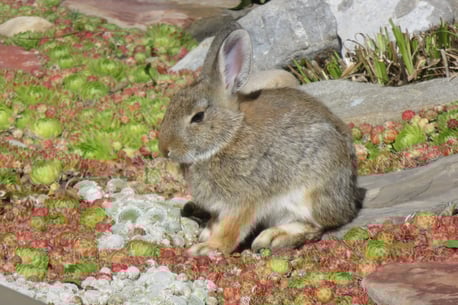
To Elsa’s joy, the rabbit, now called Misha, decided to stay. She placed a small water basin close to the entrance to his house. Bruno collects grass clippings and clover from the neighbours’ front yard and scatters them around.
Misha seems to enjoy Bruno and Elsa’s presence. When he hears them talk, he emerges from under the patio, perches on his “patio,” and watches them. It is a new routine. Even if the time of day for the ritual is altered, Misha waits for them. He must feel safe with people around, scaring predators away.'
Elsa loves animals, particularly the cute ones with soft pelts and big ears that tend to come into view first, like sails of an incoming ship. She keeps thinking about how to make Misha’s life pleasant. Gaps between the 2x6s of the deck worried her because the rain, and later the melting snow may flood his quarters. She made Bruno cover it with tiles to keep the water out. Inspired by Lewis Carroll’s Alice in Wonderland, Bruno suggested central heating, a low cushion for a bed and a supply of rabbit-sized jars of orange marmalade.
It all seems silly, but it reveals Elsa’s good heart and love of animals. Frankly, being empty nesters, Bruno and Elsa now have someone to care about, worry about and enjoy conversing with, not to mention easing the affordable housing crisis in the city!


