


.png?width=1080&height=1080&name=Favicon%20(1).png)

“I need to downsize” is a statement I hear often. I also hear “I love my garden, but it’s getting to be more than I can take care of,” and, “I was able to manage my garden this year, but I’m not sure about next year.” These comments pop up as gardeners ponder the physical demands of larger gardens.
At first, it is not the size of the space, but the maintenance that needs to be reduced. The gardener still has good mobility, so getting around is not a concern. In those cases, yard maintenance companies may do some of the heavier tasks, such as edging beds, applying mulch, and pruning.
The more formal a garden is, especially when every plant is carefully curated, the more care it requires. In this case, a shift in esthetic to more of a cottage style may keep the gardener going. It is fine to ensure each plant is in a preplanned location when you don’t mind bending over or kneeling to remove or reposition plants, but as joints get creakier, allowing plants to find their own places reduces the workload. Letting plants crowd in may not yield the open, relaxing feeling of the formal garden space, but it helps to crowd out weeds. Letting ground covers take over also helps manage weeds and reduces workload. And if for some reason you are unable to get into the garden, a more natural looking garden will camouflage the weeds that sneak in. Slowly transitioning a garden to one with more shrubs (allowed to grow in their natural form) and larger perennials also helps reduce the workload.
However, there does come a point when those changes are not enough. Moving house is a big decision. A lot of time, effort, and resources have gone into creating a garden. It can be difficult to let it go. Some gardeners move to smaller more manageable yards. Just remember that the curb appeal of your old yard is what helped sell your property and what the homeowner expects to see when they move in. You can’t just dig up your favourite plants and take them to your new yard, unless you included their removal in the documentation when you put your property up for sale.
Some downsizers move to places that may only have patios or balconies. It becomes an opportunity to try small space container gardening. Some self-watering containers might not need refilling for up to a month, so this is an option for gardeners who like to travel. If you don’t have your own gardening space, there are community and communal gardens. Most community associations have garden spaces that need support, too. And let’s not forget about the public gardens that are maintained by volunteers, such as Reader Rock Garden, The Botanical Gardens of Silver Springs, the CNIB Sensory Garden, and Lougheed House Beaulieu Gardens.
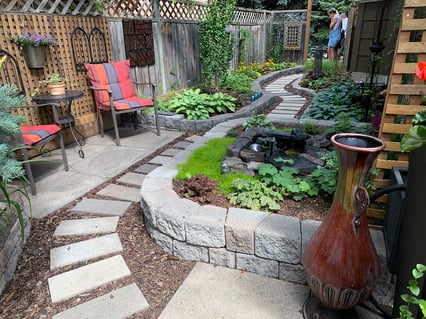 The Society recently relocated and downsized, so I’m very aware of the challenges. The garden space at Richmond Green Park was not very large, but a lot of work and special plants went into the garden. The garden space at our new home, the Silver Springs Community Association, is a smaller but better growing space. There is so much exciting potential in taking on a new garden challenge. So, if you are downsizing or moving house, it may be hard to change your garden style or to pass your creation to someone else, but the opportunities of a new location can be exciting. The change may be just the jolt needed to ignite the imagination after years of following a well-known garden path.


