


.png?width=1080&height=1080&name=Favicon%20(1).png)

Veronica is stylish. I'm talking about plants, not the famed Archie comic book character. But it is certainly a welcome character in my garden.
To have a successful perennial garden, a gardener needs to understand two things: the growing environment of their yard and which plants can thrive in those conditions. That may seem straightforward, but the variables are endless, so it usually comes to trial. You select a plant that seems right for the conditions, plant it, watch how it does that growing season, cross your fingers, and hope it comes back next spring.
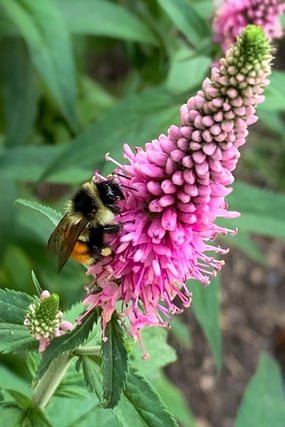
There was one challenging spot in my yard that seemed unsuitable for anything I planted, until I tried Veronica austriaca 'Crater Lake Blue'. This plant, commonly known as Austrian speedwell, or saw-leaved speedwell, is clump forming, and has loose flower spires that rise above its foliage. It starts to bloom at the end of June, truly shining in July. The flowers open first at the bottom of the spire, then the blooms progress upward with time.
'Crater Lake Blue’ has blueish-purple flowers. The tag notes that it can grow up to 45 cm tall; should be planted in full to part sun; the soil can be loamy, clayey, or sandy; and it has medium water needs.
In my garden, its spot is in part sun, because the bed is in an area shaded by ‘Northwest’ poplar branches. The soil is a bit clayey. Usually, it survives on rainwater, though in dry periods, I will do some supplemental hand watering. In this spot, it grows to about 40 cm tall.
It self-sows, so while I let it spread and fill in the troubled spot with clumps of plants, if you want to control it, cut back the flower stalks after it has finished blooming. I usually leave the flower stalks up into winter to trap snow. The birds and other creatures enjoy eating the seeds and some seeds will remain to germinate in the spring. I like to cut the stalk down in March, leaving them in a pile near where the plants grow. I find that the plant is set back a bit if I cut it back after the new growth starts to appear. I’ll clean the pile up later in the spring.
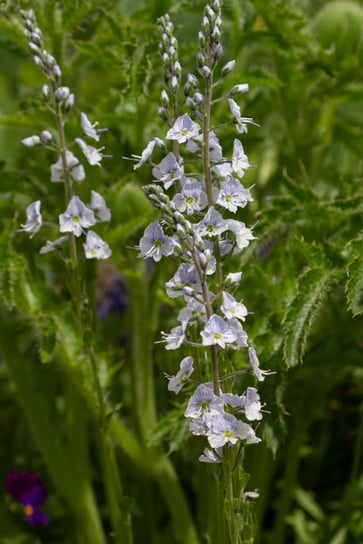
 I was so thrilled with this plant that I wanted more. When my husband wanted a gift idea, I told him to get me a Veronica. I neglected to add the species. He came home with Veronica gentianoides. The leaves of this Veronica form a rosette. It creeps and forms mats. Yes, it is a Veronica, but it is fussier about its growing conditions. It prefers evenly moist soil and tends to wilt in the heat of a summer day. It has a tall flower spike with more openly spaced blooms than that of Veronica austriaca. Its blooms are pale blue to almost white. I have seen it do well on the edge of a rain garden where organic-rich soil provides a good source of moisture. In my yard, I find it needs protection from the afternoon sun and supplemental watering.
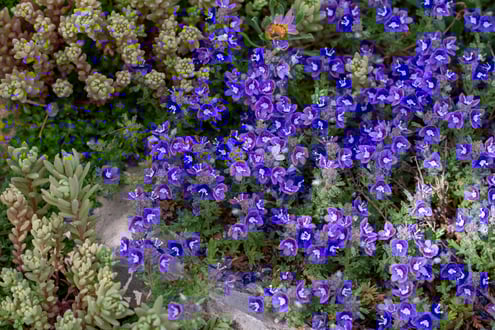
 Early on, I also planted Veronica whitleyi, also known as Whitley’s speedwell. It is a low-growing ground cover that blooms, covered in small purple flowers, at the end of May. It can grow in dry conditions and does well next to a walkway. It is a good choice for a rock garden.
Other Veronica to try are Veronica spicata and Veronica longifolia. Their cultivars come in white, shades of pink, blue, and purple. All are bumblebee magnets. They have been cultivated for height as well as colour, so you can choose from a range of sizes. Keep in mind that the tallest ones may take a couple of years to reach their full height.
When selecting plants, read the plant tag. With time, you'll be able to correlate the nursery's description of growing conditions with your yard. Regardless, often you just need to trial to determine if you've got the right plant in the right place. Give Veronica a try, there’s sure to be one suited to your garden.
To learn more about gardening in the Calgary area visit www.calhort.org.


