


.png?width=1080&height=1080&name=Favicon%20(1).png)

A long time ago, far beyond seven mountains and seven rivers, there was a small kingdom where a king, queen, and prince named Křesomysl lived. The king insisted the prince learns how to hunt. But Křesomysl did not enjoy shooting animals; he was more interested in what was growing in the forest.
One day, he noticed a mushroom peeking out of the ground that he had never seen before. He smelled it and was immediately enchanted. When the king noticed what Křesomysl was doing, he was furious: “Is this how you want to learn to hunt?”
When Křesomysl showed his father the mushroom he had found, his father waved his hand angrily. “Take it to the kitchen and have it cooked for you, but now you’d better catch some animals.” Back at the castle kitchen, the cooks were equally enchanted by what Křesomysl brought them. “But it’s a beautiful pine mushroom! We’ll prepare a delicacy from it that will make you smack your lips.”
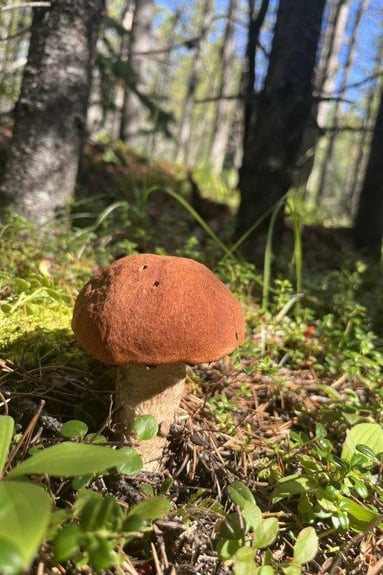 The prince had never tasted anything better in his life. The king saw his son licking his lips and tasted the food himself. He had to admit that it was delicious. His anger faded, and they abandoned their bows and arrows for baskets. From then on, mushrooms were part of many meals for royalty and guests alike. The kingdom was henceforth known as the Mushroom Kingdom. (Czech Mushroom Fairy Tale.)
****************************************
Mushrooms offer unique medical benefits, culinary appeal, scientific and environmental advances, with a serious nod to culture and folklore.
Mushroom hunting is practiced differently in many lands and follows a myriad of mythical observances. It is most popular in Central and Eastern Europe. In most Anglo-Saxon countries, mushrooming is prohibited in national parks and reserves, which puts a strain on mushroom enthusiasts in areas with sparse forest land. Bruno’s Czech-born mother was raised in England in the 1920s. Memories of her nine years there never left her. Among other things, it perplexed her that the English would not go mushroom hunting despite favourable conditions, frequent rains, and mild temperatures. During World War II, the Czech and other continental European exiles hiding from Nazis, many working for resistance or enlisted in the British army, were incredulous that the English were not mushrooming when food was scarce.
When Bruno and Elsa came to Canada, they found that Canadians also did not collect mushrooms, probably because the original settlers came from England. It is clearly the domain of immigrants, notably, Polish immigrants, who have a reputation of enjoying mushrooms with every meal. Close to Cremona, Alberta, 75 KM north of Calgary, lies an exceptionally productive pine forest, located beyond any private properties. Faithful to the unwritten code of silence amongst the mushroom hunters, its exact location cannot be revealed. Insiders know it as the “Polish Woods.” Poles keep an eye on the weather and get up early in the morning to forage for mushrooms. Bruno and Elsa lament lost opportunities by saying “the Poles were here already.” Elsa has a talent for spotting mushrooms and is adamant that the often-used term “mushroom picking” is a misnomer. During a forage, cotton, berries, fruits, and other naturally grown products are collected.
Mushrooms are mischievous, often found tucked away amongst the grasses or under low ground covers like mosses or berry fields. Truffles in France grow underground on the roots of oak, hazelnut, and beech trees. They are found by their distinctive scent and require specially trained dogs or pigs to find, so the word “hunting” fits best.
Even though a huge percentage of mushrooms are edible, the prudent amateurs should stick with what they know. Boletus edulis - the fragrant porcini mushroom or penny bun - is what Bruno and Elsa collect. About two days after a rainy day, and setting out on a workday (there’s less competition this way). Bruno and Elsa pack two lawn chairs, cutting boards, knives and bags or baskets, and go hunting. The endless forests in the foothills are majestic. It is good to be outdoors. There is often wildlife to see, including elusive wild horses. Even if the mushroom crop is disappointing, it is an excellent outing.
Once they have a collection of forest treats, Bruno and Elsa pull out their lawn chairs and have a seat while they clean and cut mushrooms. It is time to relax and drink the good coffee, which stayed warm in their thermos. The “good coffee” is a dark roast with a splash of Bailey’s cream liquor.
Bruno and Elsa had a good harvest on their most recent excursion, with 6 lbs of mushrooms in 2 hours of collecting. They use their mushrooms in soups and gravies. Fresh mushrooms fried dry in a pan with some crushed caraway seeds, salt, and pepper make a very good side dish. They freeze the rest. Mushrooms can also be dried or pickled.
*******************************************************************************
On almost all “days out,” Bruno and Elsa like to dine close to their destination. After mushrooming the best place to eat in the area is Water Valley. To get there, turn off from Highway No. 22, 37.4 kilometres north of Cochrane (4.7 kilometers south of Cremona) and drive 8 kilometres west on Highway No. 579 to where it meets the Township Road No. 304. Once known as Spencer’s Mill, the community changed its name to Water Valley in 1874 when a post office arrived.
Water Valley is a tightknit, laid-back community. It is unincorporated, and its nucleus is as minuscule as you can fi nd and call a settlement. In that lies its charm. The town center is a four-way stop, and it is where all the commerce is located. There is a post office, a public library, a chapel and a mini chapel, a massage parlour, a hardware store that looks like a vestige from the 1920s and a general store (temporarily closed), a real estate office and most importantly, two restaurants -, the Whisky Barrel Outpost, and the Water Valley Saloon. That is all, folks! Not even traffic lights.
Both restaurants serve good meals with excellent service. The Whisky Barrel Outpost is a conventional establishment, while the Saloon is a large building with western décor. The outside of the building is shabby and well-worn, but inside the saloon atmosphere is Canadian Western, with a stuffed buffalo head above the fireplace and knick-knacks on the mantelpiece. Trophies hang on the walls, and saddles straddle the rafters. A bandstand by the dance floor, complete with a honky-tonk piano, and TV showing nonstop rodeo competitions, including the Calgary Stampede, provide ambiance. Judging by the battery of mailboxes across the street from the Saloon and the fact that the two restaurants are always full, there must be more people in the woods than the advertised 200 residents. Visitors can explore the surrounding natural beauty, enjoy outdoor activities, and experience a taste of small-town hospitality.
A story about a day out featuring the excitement of mushroom hunting should end on a culinary note. Elsa is happy to provide a recipe that will not disappoint:
Hungarian Mushroom Soup 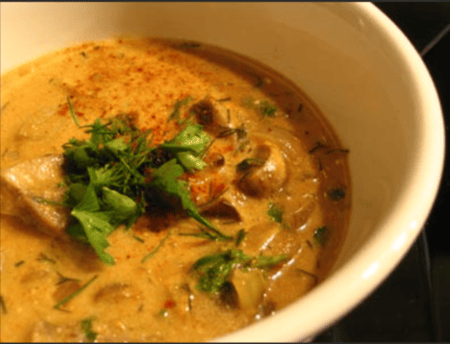
Ingredients
- 3 tablespoons (Tbs) butter
- ½ large onion, chopped
- 2 tsp Hungarian paprika
- 2 tsp dill weed (fresh or dried)
- ½ tsp salt
- ½ tsp black pepper
- 3 Tbs flour
- 1 cup milk
- 1 cup chicken stock
- 1 ½ cup cold water
- 2 cups sliced mushrooms (wild or white or Cremini)
- 1 Tbs soy sauce
- 1 Tbs lemon juice
- ¼ cup sour cream (may use a bit more)
- 1 ½ Tbs chopped parsley
Directions
- In a pan, sauté mushrooms with a pinch of salt until the fluids cook off . Set aside.
- In a large pot, sauté the onion in butter. Add paprika, dill weed, salt and pepper.
- Cook until tender.
- Sift in flour, creating a roux.
- Add milk, cold water, and, slowly stirring, add stock, and bring to a boil.
- Add pre-sautéed mushrooms and simmer for 20 minutes.
- Remove from heat and add soy sauce, lemon juice, sour cream and parsley.
Serves 4.


