


.png?width=1080&height=1080&name=Favicon%20(1).png)

The story of the Little Engine has been told many times: a stranded train cannot find an engine willing to take it over difficult terrain. “I can’t; that is too much to pull for me,” says the great engine built for hard work. The train asks for another engine, and another, only to hear excuses and be refused. Finally, the little engine is willing to try thinking that “it can.” As it nears the top of the grade, it slows down. “I think I can, I think I can,” puffed the little locomotive. It reached the top by drawing on all its reserves and then descended, congratulating itself
by saying, “I thought I could, I thought I could.”
*****
It is unusual to drive through the largest industrial area on the east side of Calgary in pursuit of culture. But today, Bruno and Elsa took a one-and-a-half-hour drive northeast to see a play called ‘Dream’ by Terry Bachinski at the Rosebud Theatre.
 At first, the prairies are flat, but after Strathmore, they exit the Trans-Canada Highway and take the scenic highway No. 840 to get to Rosebud. Here, the Alberta prairies undulate. These are the foothills of the foothills. Broader and deeper valleys were carved out by the mighty Bow, the Oldman, the South Saskatchewan and the Red Deer rivers flowing from the east slopes of the Rockies on their way southeast and in a huge curve, gradually turning northeast, ultimately to Hudson Bay.
Small tributaries gently cut into the terrain, forming petite enclaves with patches of trees in which farmsteads and small settlements are nestled. Rosebud, once a small village, now unincorporated, is one of them. Cree people called the enclave Akokiniskway, translated as, “By the river of many roses.” It lies near the edge of the Canadian Badlands, the storied land of dinosaurs. The first recorded settlers were James and Eliza Wishart, who came in 1885. It is local legend that James paraphrased the Old Testament: “Here’s the Promised Land, we go no further.”
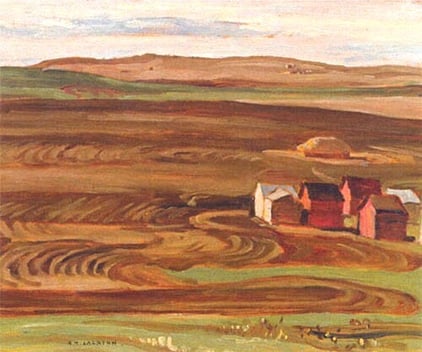 The beauty of the tiny valley has attracted many people throughout the years, from nature lovers to artists. A. Y. Jackson, a member of the Group of Seven, and Henry George Glyde painted the area in the 1940s. The Canadian Northern Railway built a line through Rosebud in the early 20th century. The railway station was a simple coal-heated boxcar until 1919, when a proper building was constructed. The last trains on the line through Rosebud stopped running around 2008, after almost a century of service. Over the years, farming and coal mining have been the region’s primary industries.
When Severn Creek School closed its doors in 1972, the good times ended. Many of the local businesses closed, and the hamlet’s population dropped to under a dozen people. It was a decline familiar to other prairie towns. What seemed to be the final nail in its coffin was when the only general store, the Haskayne Kenney Mercantile, closed the same year. Perhaps that was the moment when the proverbial stranded train started looking for an engine. The Haskayne Kenney Mercantile building was sold in 1973 to Crescent Heights Baptist Church, which was looking to establish a youth retreat. It is from this humble beginning that the Rosebud School of the Arts evolved.
The little locomotive started up the hill – “I think I can, I think I can”. In 1983, the school launched what is now known as Rosebud Theatre. Students and staff wrote, rehearsed and performed an original production on an outdoor stage and named the production a “Commedia del’Arte. To this day, 174 shows have been staged. Rosebud became a tourist hotspot in Alberta, visited by over 35,000 people each year despite not having a convenience store, a gas station, or a population of more than 100. The story of the little train is now concluded. “I thought I could, I thought I could.”
*****
Most visitors come for the theatre, run by the Rosebud School of the Arts, the main industry in town. However, a place dominated by artists, actors, and assorted creative people is bound to be a bit zany, so there is more to see before the dinner and the show starts, and it can be a complete “day out.”
 Akokiniskway Art Gallery is located in the historic Rosebud Church. The Centennial Museum displays artifacts of Rosebud’s throughout the years. Two-room shack nearby calls itself the Gallery of Unique Gifts. It is too small to have been a dwelling in the past, but who knows?
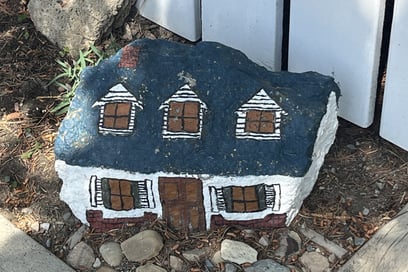
Farther down the street, someone’s house has a working model train layout in the front yard plus other whimsical “folk art” like a picture frame placed on an easel in front of a real flower pot, and a wheelbarrow standing up with handles for legs and the wheel for a head, is dressed as a gardener. That stretches one’s imagination a bit. Rocks on the edge of a sidewalk are painted like little houses.
There is no way around the fact that this is a one-industry town. One can be fooled by the signs on stores and other attractions showing their opening hours. Most of them ignore the posted hours of operation and simply open either very close to show time, while others open after the show’s end. Visiting the theatre starts at the main intersection in town. It cannot be missed; there is only one.
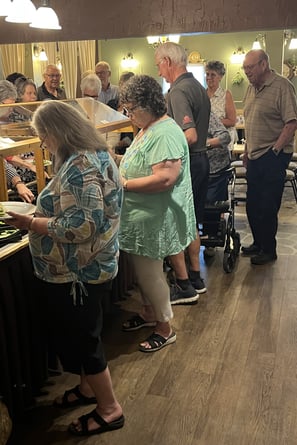
The former general store on the southwest corner was repurposed to be the ticket office and the restaurant, with buffet meals served in large or small rooms, and in a lean-to addition called a “greenhouse room.”
 This annex is more intimate, with tables for two, but also most peculiar, with the heating and air conditioning registers slapped on the walls high up by the ceiling, and steep stairs leading down to the underworld, implying that the whole thing was an afterthought, but it adds to its character. The buffet is good: the food is substantial and plentiful, and the service is excellent.
 Rosebud’s main theatre is known as the Opera House, and is across the street from the main building. It has a seating capacity of 232. The Studio venue, which is another more intimate performance space on campus, seats 70.
*****
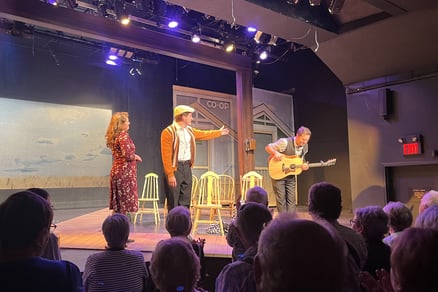
Bruno and Elsa came to see the musical called ‘Dream’ by Terry Bachynski.
The author wrote: “Developing the show with Rosebud Theatre has been a dream come true for me. If you had asked me even six years ago if I would ever write a musical, I would have said, “nope.” Then COVID-19 happened. I had a year in our house with my new piano and plenty of time. ‘Dream’ tells the story of my father Eddie’s troubled youth and his desire to build a life for himself, notwithstanding the hardships encountered along his path. It is an amazing story, and I think he was a remarkable man.”
In the opening number, a young Eddie says his dream is to have a room of his own with a bed and maybe two chairs, and people who care about him. It’s his way of saying he wants a loving family. His father was a drunk who beat his mother, him, and his brother. He had been sent to foster farms previously, but it was not the family he dreamed of. They made him sleep in the barn, and eat leftovers, and the abuse was emotionally scarring. So, he kept escaping and finding himself in trouble. Gran, the widow he is sent to as a last resort, not only offers him her youngest son’s room but also shares her meals with him. Eddie is grateful, but he must learn discipline and fit into the community.
*****
It is a true-life story, put together very cleverly. It is billed as the “New Canadian Musical”, akin to the best of Broadway. However, it is not pretentious or showy, and to its credit, not as full of clichés as the big cities shows often are. The play is a pure Canadiana placed in a small country town in Ontario, a hundred years ago. It was a place inhabited by deeply religious and decent, yet street-smart people. Life was simple, unassuming, and the citizens - relaxed. Materially, they had everything they needed, the philosophy so beautifully expressed in the lyrics of The Co-op Song – “If you can’t buy it in the Coop, you don’t need it!”
If the Rosebud Theatre is not professionally on level with Broadway and other major theatres, its strength is exactly in that fact. Even the orchestra consists of only a piano, banjo, guitar and a bass, but it works perfectly in the intimate theatre. As Eddie and Joanne, Mark Kazakov and Karyssa Komar, respectively, and the rest of the players have strong, expressive voices, they do justice to Bachynski’s songs and dialogue.
‘Dream’ has a world premiere in Rosebud, and it is a good thing, as the old wisdom is that “the context of the environment in which an art piece (in this case, a show) is placed contributes significantly to its appearance.” A hundred years later, one would be hardly pressed to duplicate the atmosphere, time, and place this story tells, but Rosebud came in as close as could be. The little hamlet today is a throwback to the same time, lifestyles, zest for life, and willingness to work hard and make something out of what fate had dealt them.‘Dream’ is an uplifting musical about family, community, faith, and the healing power of redemption, and it is bringing Rosebud audiences to their feet. The show will be running until August 30, 2025.


